.png)
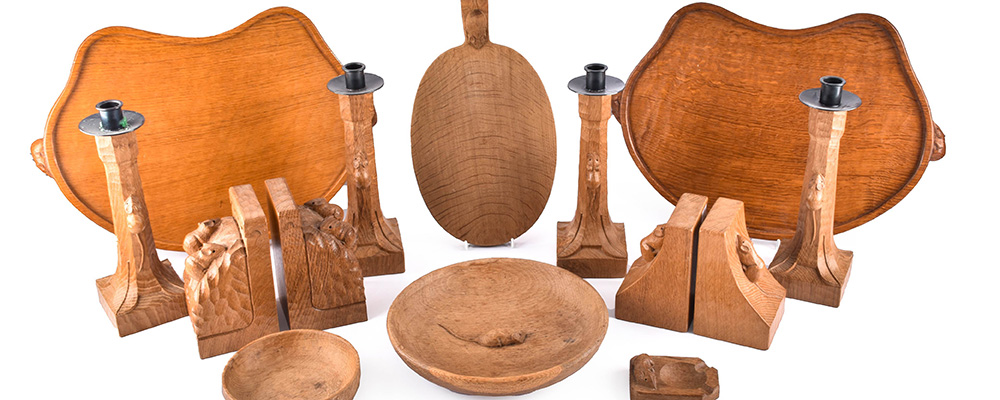
Few marks in English furniture are as instantly recognisable, or as affectionately regarded, as a small carved mouse climbing a piece of oak. Robert 'Mouseman' Thompson (1876-1955) of Kilburn, North Yorkshire, built one of the great craft workshops of the twentieth century on solid English oak, simple hand tools and that famous signature, and his work is a fixture of our sales and a favourite with collectors.
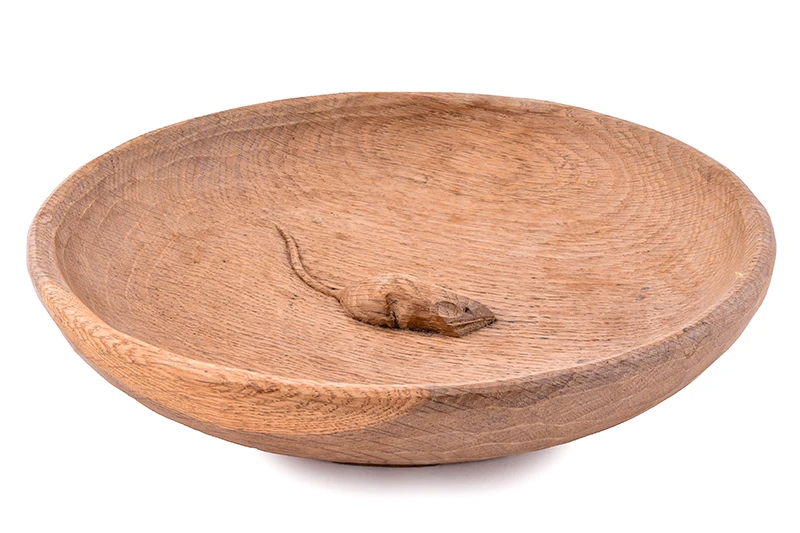
Thompson took over his father's joinery business in the village of Kilburn and turned deliberately away from the machine age. Inspired by the medieval carving of nearby Ripon Cathedral and by the ideals of the Arts and Crafts Movement, he worked only in English oak, shaped with an adze to leave the rippled surface that collectors prize, and jointed honestly in the old way. Church furnishings made his name, his work fills churches, schools and colleges across the north of England, and domestic furniture and smaller wares followed.

The trademark is said to date from the 1920s, when a remark about being 'as poor as a church mouse' prompted Thompson to carve one on the piece in hand. It stayed, a quiet emblem of humility and industry, and every genuine piece from the workshop carries one. The mouse itself helps with dating: early examples have carved front legs, a detail simplified in later years, and the workshop, which continues today in Kilburn as Robert Thompson's Craftsmen, still carves it on everything it makes.
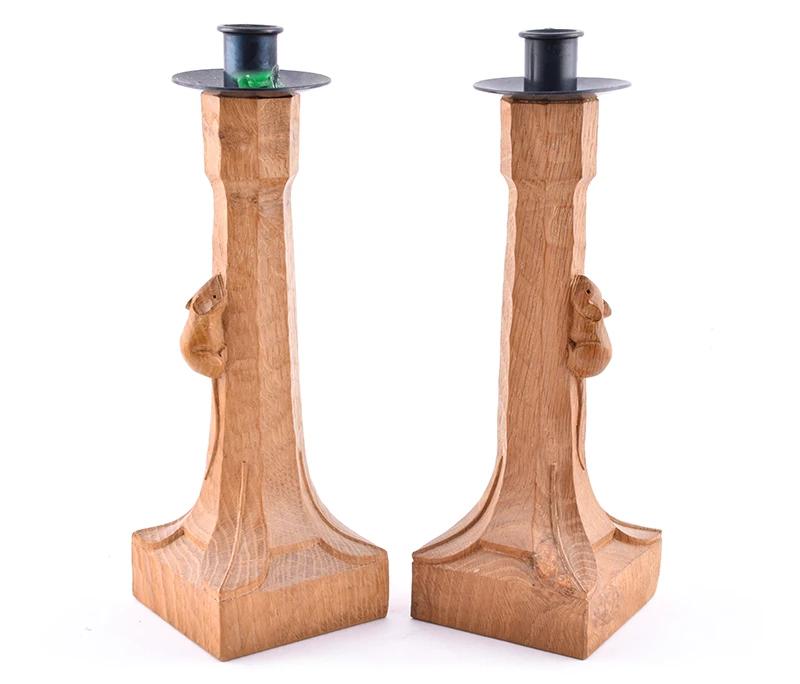
The market divides broadly into furniture and smaller wares. Dining tables, dressers, sideboards and sets of chairs command the strongest prices, particularly early pieces made in Thompson's own lifetime, where the colour and adzed surface have mellowed with age. Bowls, trays, candlesticks, ashtrays, bookends and cheeseboards give collectors a way in at gentler levels and sell dependably in every sale. Condition and originality of surface matter, a piece that has kept its waxed patina is worth appreciably more than one stripped or refinished, and unusual forms attract real competition when they appear.

The rare triple-mice bookends pictured, angular in form with two climbing mice and a third peering through the pierced sides, were offered at Aubreys and illustrate the sort of piece that seldom reaches the open market. When something out of the ordinary surfaces, the workshop's devoted following makes itself felt.
Mouseman pieces turn up regularly in Surrey and London homes, often bought on Yorkshire holidays decades ago or inherited from parents who furnished with them new. If you have a piece, or a houseful, our furniture and decorative arts specialists offer a free valuation from photographs or at home, and can date a piece from its mouse, its joints and its surface.
